German Pilot Line for Superconducting Quantum Circuits
SUPREME, a European project, is building Europe's first pilot line for superconducting quantum chips. Coordinated by VTT and funded by the EU Chips Joint Undertaking together with national funding agencies, it unites 23 partners from eight member states around fabrication sites in Finland, Germany and the Netherlands. WMI develops and qualifies superconducting circuit processes for Josephson junctions, low-loss materials and 3D integration. The processes are validated at qubit level, and shared with the pilot line to advance next generation superconducting quantum circuits.
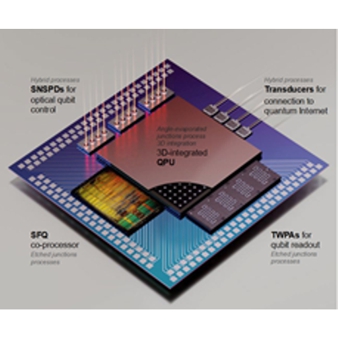
Superconducting quantum circuits are among the most advanced platforms for quantum computing, sensing and communication. What currently limits progress beyond laboratory prototypes is less the underlying physics than the fabrication: yield, repeatability and long-term stability. SUPREME (Superconducting European Quantum Pilot Line) addresses exactly this bottleneck. Over six years, the consortium develops stable, high-yield fabrication processes and opens them to European start-ups, SMEs, industry and academia through process design kits (PDKs) and shared piloting services, keeping process know-how and IP creation within Europe.SUPREME is coordinated by VTT (Finland) and funded by the EU Chips Joint Undertaking together with national funding agencies. It brings together 23 partners from eight EU member states and establishes three central fabrication sites, in Finland, Germany and the Netherlands. The German site is located in Garching and the wider Munich area. Supreme-DE, the German part of the pilot line, is carried by Peak Quantum, the Technical University of Munich together with the Walther-Meißner-Institut, the Max Planck Semiconductor Laboratory, Infineon Technologies, several Fraunhofer institutes (EMFT, IZM, IPMS, IAF) and the Leibniz Institute of Photonic Technology, closely coupled to the Munich Quantum Valley ecosystem.Technically, the pilot line concentrates on angle-evaporated and etched Josephson junctions, 3D integration methods and hybrid quantum processes. These are validated in pilot-line demonstrators: 3D-integrated qubit assemblies for large-scale quantum processing units, travelling-wave parametric amplifiers and superconducting nanowire single-photon detectors. The first validated processes are to be released to external users via PDKs in 2027.At the Walther-Meißner-Institut, the project builds on many years of experience with the fabrication and characterisation of superconducting circuits. The institute contributes low-loss materials and process development in its own clean room and, in particular, device-level qualification: resonator and junction test structures, measurements of qubit coherence and gate fidelity, and the feedback from measured device performance into process parameters. This closes the loop between wafer-level process control and the figures of merit that ultimately matter for a quantum processor.