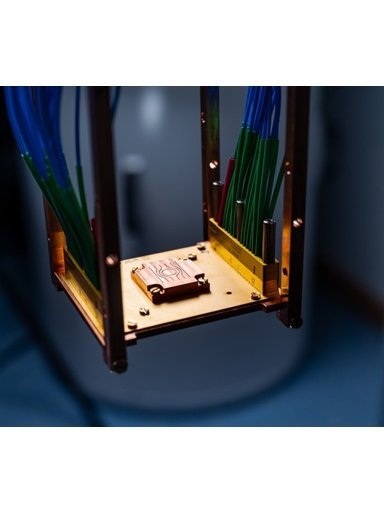
Munich Quantum Valley 2
Munich Quantum Valley (MQV) bundles the quantum-computing activities of seven Bavarian research organisations: the BAdW, DLR, the Fraunhofer-Gesellschaft, FAU, LMU Munich, the MPG and TUM. Funded by the Bavarian State Ministry of Science and the Arts from the Hightech Agenda Bayern, MQV develops and operates competitive quantum computers. In the second funding phase, WMI contributes superconducting quantum processors to eventually operate logical qubits.
Munich Quantum Valley is the Bavarian initiative for quantum science and quantum technologies, with the primary goal of developing and operating competitive quantum computers in Bavaria. Its seven members - the Bavarian Academy of Sciences and Humanities (BAdW), the German Aerospace Center (DLR), the Fraunhofer-Gesellschaft, Friedrich-Alexander-Universität Erlangen-Nürnberg, Ludwig-Maximilians-Universität München, the Max Planck Society and the Technical University of Munich - work together in multidisciplinary consortia that follow a full-stack model: qubit hardware, cryogenic and control technology, compilation and error mitigation, algorithms, applications and integration into high-performance computing. MQV pursues several hardware platforms side by side, among them superconducting circuits spearheaded by WMI. In the first funding period, the consortia realised full-stack quantum-computer demonstrators in the noisy intermediate-scale (NISQ) regime and made them remotely accessible to research and industry. The second phase shifts the emphasis from demonstrating a working stack towards scaling it: larger and more reliable processors, higher gate and readout fidelities, systematic benchmarking, and the first building blocks of quantum error correction.The WMI contributes the superconducting-qubit hardware layer and its theoretical underpinning. The institute designs, fabricates and operates superconducting quantum processors in its own clean room and dilution refrigerators, with a focus on low-loss materials and fabrication, novel and intrinsically protected qubit types such as fluxonium, tunable and parametric coupling architectures, optimal-control and closed-loop calibration methods for high-fidelity gates, and scalable readout. Together with the other MQV partners, these contributions feed directly into the Bavarian quantum-computer demonstrators and their operation for external users.