Manipulation and control of the altermagnetic spin splitting
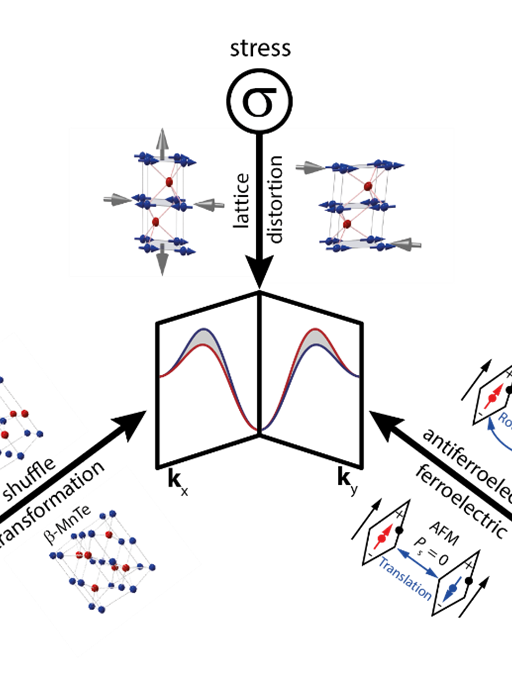
Altermagnetism with compensated, collinear spin structure intrinsically break spin degeneracy at finite momenta away from high symmetry points, resulting in spin-split magnon bands with well-defined chirality. This unconventional magnetic order offers promising opportunities for advanced spintronic devices. A crucial step towards the realization of such devices is to achieve a comprehensive understanding and external control of the altermagnetic phase. Within the DFG priority program SPP 2558, we propose to use temperature, strain, and electric fields as external control parameters. Their effects on the magnon band splitting in altermagnetic thin films will be studied using laboratory-based magnetoresistance measurements and advanced X-ray scattering techniques.
Altermagnetism represents a fundamentally new magnetic phase, akin to ferromagnetism and antiferromagnetism. This unconventional magnetic phase not only reshapes the understanding of magnetic materials, it also promises advanced functionalities in future devices, as it combines the complementary advantages of ferromagnets and antiferromagnets, while utilizing new effects. In this context, the ability to control and manipulate the properties of altermagnetic thin films is a key challenge for future research. Within the DFG priority program SPP 2558 “Unconventional Magnetism: Beyond the s-wave magnetism paradigm”, we therefore propose a comprehensive study of the manipulation and control of the altermagnetic phase in order to pave the way for novel, next-generation spintronic devices. We will utilize diffusionless phase transitions induced by temperature and strain using thin films of the prototypical altermagnetic materials MnTe and CrSb to alter the well-defined spin-splitting of their magnonic bands. Furthermore, we propose to tune the altermagnetic properties by external electric fields in multiferroic thin film materials. Their effects on the magnon band splitting in altermagnetic thin films will be studied using laboratory-based magnetoresistance measurements and advanced X-ray scattering techniques. This will gain fundamental insights into the mechanisms governing altermagnetism and to enable control over transitions between altermagnetic and conventional antiferromagnetic order.