|
|
Oxides for Spintronics
Transition metal oxides show fascinating physical properties such as high temperature superconductivity, ferro- and antiferromagnetism, ferroelectricity or even multiferroicity. The enormous progress in oxide thin film technology allows us to integrate these materials with semiconducting, normal conducting, dielectric, or non-linear optical oxides in complex oxide heterostructures, providing the basis for novel multi-functional materials and making them suitable for various spintronic applications.
- Epitaxial Thin Films Grown by Laser-MBE
Laser molecular beam epitaxy (laser-MBE), also known as pulsed laser deposition, allows to grow oxide thin films with crystalline quality approaching semiconductor standards. Moreover, in close analogy to the well known GaAs/AlAs heteroepitaxy it is possible to grow complex heterostructures composed of different oxides on suitable substrates in a layer-by-layer or block-by-block mode.
We are steadily working on
- Fabrication of high-quality epitaxial oxide thin films and heterostructures on different substrates
- Development of multifunctional materials based on heteroepitaxial oxide multilayers
Recent Publications:
Spintronic oxides grown by laser-MBE
Matthias Opel
J. Phys. D: Appl. Phys. 45, 033001 (2012).
Novel Multifunctional Materials Based on Oxide Thin Films and Artificial Heteroepitaxial Multilayers
M. Opel, S. Geprägs, E.P. Menzel, A. Nielsen, D. Reisinger, K.-W. Nielsen, A. Brandlmaier, F.D. Czeschka, M. Althammer, M. Weiler, S.T.B. Goennenwein, J. Simon, M. Svete, W. Yu, S.-M. Hühne, W. Mader, R. Gross,
Phys. Status Solidi A 208, 232 (2011).
|
 |
- The Half-Metallic Ferromagnet Magnetite (Fe3O4)
Magnetite (Fe3O4), known and used for more than 3,000 years as the oldest magnetic mineral, is a ferrimagnetic iron oxide with a high Curie temperature of 860 K. Band structure calculations predict half-metallicity at room temperature. We investigate
- Anomalous Hall effect and its scaling behavior
- Tuning of electrical and magnetic properties by Zn2+ substitution
- Control of magnetization by strain
Recent Publication:
Epitaxial ZnxFe3-xO4 thin films: A spintronic material with tunable electrical and magnetic properties
D. Venkateshvaran, M. Althammer, A. Nielsen, S. Geprägs, M.S.R. Rao, S.T.B. Goennenwein, M. Opel, R. Gross,
Phys. Rev. B 79, 134405 (2009).
|
 |
- The II-VI Oxide Semiconductor Zinc Oxide (ZnO)
Zinc Oxide (ZnO) is a naturally n-type, wide bandgap semiconductor (Eg = 3.4 eV), used commonly in sun creams for blocking UV radiation or technically in semiconductor devices as a transparent conducting oxide. It is under discussion whether or not it can be transformed into a dilute magnetic semiconductor using different preparation processes. We focus on
- Doping with magnetic ions, e.g. Co2+
- Heterostructures of ZnO/Fe3O4 for spin injection experiments
- Fabrication of p-type ZnO using nitrogen doping
Recent Publications:
Advanced spectroscopic synchrotron techniques
to unravel the intrinsic properties of dilute magnetic oxides: the case of Co:ZnO
A. Ney, M. Opel, T.C. Kaspar, V. Ney, S. Ye, K. Ollefs,
T. Kammermeier, S. Bauer, K.-W. Nielsen, S.T.B. Goennenwein,
M.H. Engelhard, S. Zhou, K. Potzger, J. Simon, W. Mader,
S.M. Heald, J.C. Cezar, F. Wilhelm, A. Rogalev, R. Gross, S.A. Chambers,
New. J. Phys. 12, 013020 (2010).
All oxide ferromagnet/semiconductor epitaxial heterostructures
A. Nielsen, A. Brandlmaier, M. Althammer, W. Kaiser, M. Opel, J. Simon, W. Mader, S.T.B. Goennenwein, R. Gross,
Appl. Phys. Lett. 93, 162510 (2008).
|
 |
- Perovskites and Double Perovskites
Perovskites of the chemical composition ABO3 with B a transition metal ion show versatile physical properties from ferromagnetism to superconductivity. The high-temperature superconductors (e.g. YBa2Cu3O7) as well as the CMR doped magnanites (e.g. La2/3Ba1/3MnO3) belong to this class of materials. We study
- High-quality epitaxial growth on different substrates using laser-MBE
- Coupling between magnetic and dielectric properties
- Influence of strain implied by ferroelectric BaTiO3 substrates
Recent Publications:
Giant magnetic anisotropy changes in Sr2CrReO6 thin films on BaTiO3
F.D. Czeschka, S. Geprägs, M. Opel, S.T.B. Goennenwein, R. Gross,
Appl. Phys. Lett. 95, 062508 (2009).
Epitaxial growth and magnetic properties of Sr2CrReO6 thin films
S. Geprägs, F.D. Czeschka, M. Opel, S.T.B. Goennenwein, W. Yu, W. Mader, R. Gross,
J. Magn. Magn. Mater. 321, 2001 (2009).
Multiferroic materials based on artificial thin film heterostructures
S. Geprägs, M. Opel, S.T.B. Goennenwein, R. Gross,
Phil. Mag. Lett. 87, 141 (2007).
|
 |
Multifunctional Spin Hybrids and Spin Measurements
Multifunctional materials and devices unite physical properties which usually do not coexist in the solid state. We fabricate such multifunctional systems, mostly in the form of hybrid samples: Materials with different functionalities (e.g., particular ferromagnetic, ferroelectric, superconducting, elastic, thermal, or optical properties) are combined in a heterostructure or a multilayer stack. The corresponding experimental investigations are focussed on the modification and the controlled manipulation of the ferromagnetic properties in multifunctional hybrids and multifunctional nanostructures.
- Spin Mechanics
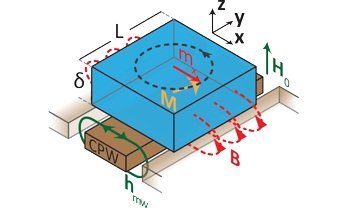
Upon attaching a ferromagnetic thin film onto a piezoelectric actuator, one obtains a multifunctional hybrid. In such a device, the magnetic and piezoelectric properties are connected because of elastic coupling across the shared interface. Taking advantage of this "spin mechanics" interaction, it is possible to establish a voltage-control of magnetization orientation in the hybrid devices.
We explore
- The opportunities and the fundamental limits of the spin mechanics concept
- The influence of the ferromagnet's properties, in particular crystallinity and magnetic anisotropy, on the voltage-control of magnetization
- Spin mechanics in (nanoscale) ferromagnetic / ferroelectric heterostructures
- Spin mechanics at radio frequencies, i.e., elastically driven ferromagnetic resonance
Recent publications:
Elastically driven ferromagnetic resonance in nickel thin films
M. Weiler, L. Dreher, C. Heeg, H. Huebl, R. Gross, M. S. Brandt, S. T. B. Goennenwein,
Phys. Rev. Lett. 106, 117601 (2011).
Voltage controlled inversion of magnetic anisotropy in a ferromagnetic thin film at room temperature
M. Weiler, A. Brandlmaier, S. Gepraegs, M. Althammer, M. Opel, C. Bihler, H. Huebl, M.S. Brandt, R. Gross, S.T.B. Goennenwein,
New J. Phys. 11, 013021 (2009).
Ga1-xMnxAs/piezoelectric actuator hybrids: A model system for magnetoelastic magnetization manipulation
C. Bihler, M. Althammer, A. Brandlmaier, S. Geprägs, M. Weiler, M. Opel, W. Schoch, W. Limmer, R. Gross, M.S. Brandt, S.T.B. Goennenwein,
Phys. Rev. B 78, 045203 (2008).
|
 |
- Spin Dynamics
Ferromagnetic resonance (FMR) allows to quantify the magnetic free enthalpy, the magnetic anisotropy, and the Gilbert damping of ferromagnets. We extensively use FMR to characterize multifunctional spin hybrids as well as single ferromagnetic films. Depending on the physical properties in question, we use
- Cavity-based FMR at 10 GHz (X-band) or 24 GHz (K-band)
- broadband FMR using coplanar waveguides (0-24 GHz)
- FMR as a function of temperature (300 K > T > 1.7 K routinely; FMR at ~100 mK recently established)
Recent Publications:
Electroelastic hyperfine tuning of phosphorus donors in silicon
L. Dreher, T. A. Hilker, A. Brandlmaier, S. T. B. Goennenwein, H. Huebl, M. Stutzmann, M. S. Brandt,
Phys. Rev. Lett. 106, 037601 (2011).
Advanced techniques for all-electrical spectroscopy on spin caloric phenomena
R. Huber, P. Klemm, S. Neusser, B. Botters, A. Wittmann, M. Weiler, S.T.B. Goennenwein, C. Heyn, M. Schneider, P. Böni, D. Grundler,
Sol. Stat. Comm. 150, 492 (2010).
Spin-wave resonances and surface spin pinning in Ga1-xMnxAs thin films
C. Bihler, W. Schoch, W. Limmer, S.T.B. Goennenwein, M.S. Brandt,
Phys. Rev. B 79, 045205 (2009).
|
 |
- Spin Transport and Spin Caloritronics
Because of spin-orbit coupling, the resistivity of ferromagnets characteristically depends on the magnetization orientation. The corresponding anisotropic magnetoresistance (AMR) and anomalous Hall effect (AHE) can be exploited for magnetometry purposes. Using magneto-transport experiments, we study
- the magnetic anisotropy of single-crystalline ferromagnetic thin films
- the magnetization orientation in ferromagnetic thin films
- the scaling relations between AHE and resistance.
In analogy to the magneto-galvanic voltages arising due to charge current flow, magneto-thermo-galvanic effects describe the voltages ocurring in ferromagnets as a response to thermal gradients (temperature differences). These phenoma are referred to as spin-caloritronic transport, and investigated intensively in the framework of SPP 1538. We focus on
- anisotropic magneto-thermopower (magneto-Seebeck effect) and anomalous Nernst effect
- spin Seebeck effect, both in electrical conductors and in electrical insulators
- the generation and use of local temperature gradients for spatially resolved spin caloritronic experiments.
Pure spin currents, i.e., flows of angular momentum without accompanying net charge currents, are another intriguing topic in spin transport. We use the inverse spin Hall effect to detect pure spin currents, both in
- spin pumping experiments, in which a spin current is driven by magnetization dynamics, and
- in spin caloritronic (Spin Seebeck) experiments.
Recent Publications:
Scaling Behavior of the Spin Pumping Effect in Ferromagnet-Platinum Bilayers
F.D. Czeschka, L. Dreher, M.S. Brandt, M. Weiler, M. Althammer, I.-M. Imort, G. Reiss, A. Thomas, W. Schoch, W. Limmer, H. Huebl, R. Gross, S.T.B. Goennenwein,
Phys. Rev. Lett. 107, 046601 (2011).
Magnetic anisotropy in (Ga,Mn)As: Influence of epitaxial strain and hole concentration
M. Glunk, J. Daeubler, L. Dreher, S. Schwaiger, W. Schoch, R. Sauer, W. Limmer, A.
Brandlmaier, S.T.B. Goennenwein, C. Bihler, M.S. Brandt,
Phys. Rev. B 79, 195206 (2009).
Anomalous Hall Effect in Magnetite: Universal Scaling Relation Between Hall and Longitudinal Conductivity in Low-Conductivity Ferromagnets
D. Venkateshvaran, W. Kaiser, A. Boger, M. Althammer, M.S. R. Rao S.T.B. Goennenwein, M. Opel, R. Gross,
Phys. Rev. B 78, 092405 (2008).
|
 |
 |
The WMI subgroup "Magnetism & Spintronics" in December 2010. |
|