Microwave Quantum Communication

We aim at developing novel components, experimental techniques, and the theoretical foundations of microwave quantum communication based on the quantum properties of continuous-variable propagating microwaves.
ICON project
Recent projects
Rudolf Gross, Stefan Filipp, Hans Huebl, Matthias Althammer, Kirill Fedorov, Florian Fesquet, Kedar Honasoge, Achim Marx, Nadezhda Kukharchyk, Stephan Geprägs, Thomas Luschmann, Ana Strinić
ICON publication
Recent publications
Lukas Vogl, Gerhard B. P. Huber, Ana Strinić, Achim Marx, Stefan Filipp, Kirill G. Fedorov, Rudolf Gross, Nadezhda P. Kukharchyk
Research Article | arXiv:2602.11739
Nadezhda P. Kukharchyk, Holger Boche, Christian Deppe, Kirill G. Fedorov, Martin E. Garcia, Ilja Gerhardt, Rudolf Gross, Thomas Halfmann, Hans Huebl, David Hunger, Wolfgang Kilian, Roman Kolesov, Juliane Krämer, Alexander Kubanek, Kai Müller, Boris Naydenov, Janis Nötzel, Anna P. Ovvyan, Wolfram H. P. Pernice, Gregor Pieplow, Cyril Popov, Tim Schröder, Kilian Singer, Janik Wolters
Research Article | arXiv:2602.10621
W. K. Yam, M. Renger, S. Gandorfer, R. Gross, K. G. Fedorov
Research Article | arXiv:2512.23388
P. Oehrl, F. Fesquet, K. E. Honasoge, M. Handschuh, A. Marx, R. Gross, K. G. Fedorov, H. Huebl
Research Article | arXiv:2512.17490
Ana Strinic, Patricia Oehrl, Achim Marx, Pavel A. Bushev, Hans Huebl, Rudolf Gross, Nadezhda Kukharchyk
Research Article | Physical Review B 111, 214430  (2025)
Preprint: arXiv:2501.04657

Our long-term vision is to develop distributed quantum computing & communication based on microwave quantum local area networks (QLANs). Microwaves are the natural frequency regime of several quantum computing platforms (superconducting circuits, NV centers, quantum dots). Therefore, microwaves are the natural frequency range for quantum communication between such platforms. In particular, no frequency conversion is required which usually is inefficient and related to significant losses. Moreover, microwaves can be distributed via superconducting cables with surprisingly small losses, eventually allowing for quantum communication and cryptography applications.

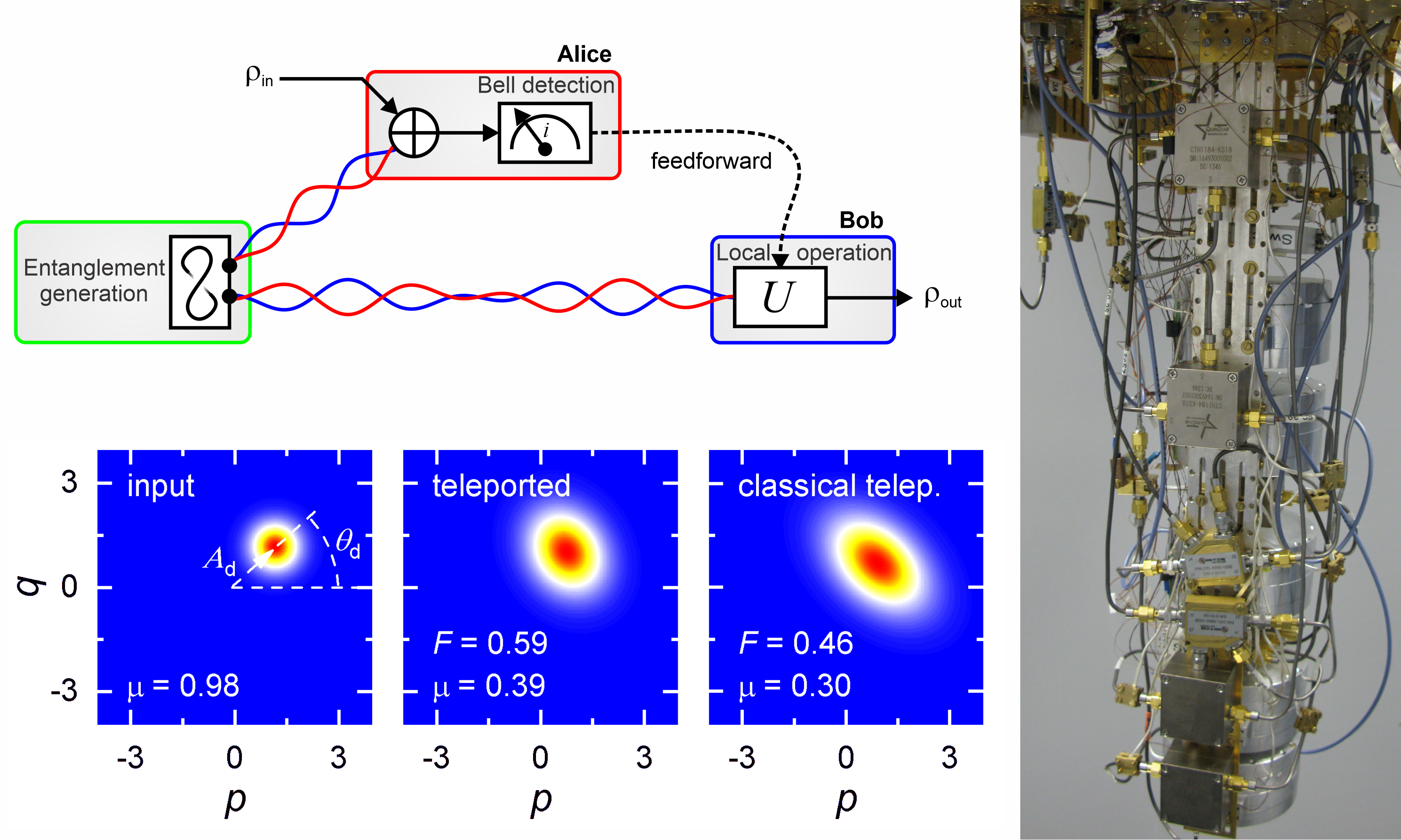
An important near-term goal is the demonstration of a QLAN via quantum teleportation and to develop a roadmap to real-life applications for the second/third phase of the European Quantum Technology Flagship. An important enabling technology for achieving the goal is the development of a microwave QLAN cable connecting the millikevin stages of two dilution refrigerators. This technology is developed by WMI together with its industrial partner Oxford Instruments within the European Quantum Technology Flagship project QMiCS.  The resulting “enabling” commercial products are beneficial for quantum technologies at microwave frequencies in general.